F216
F216

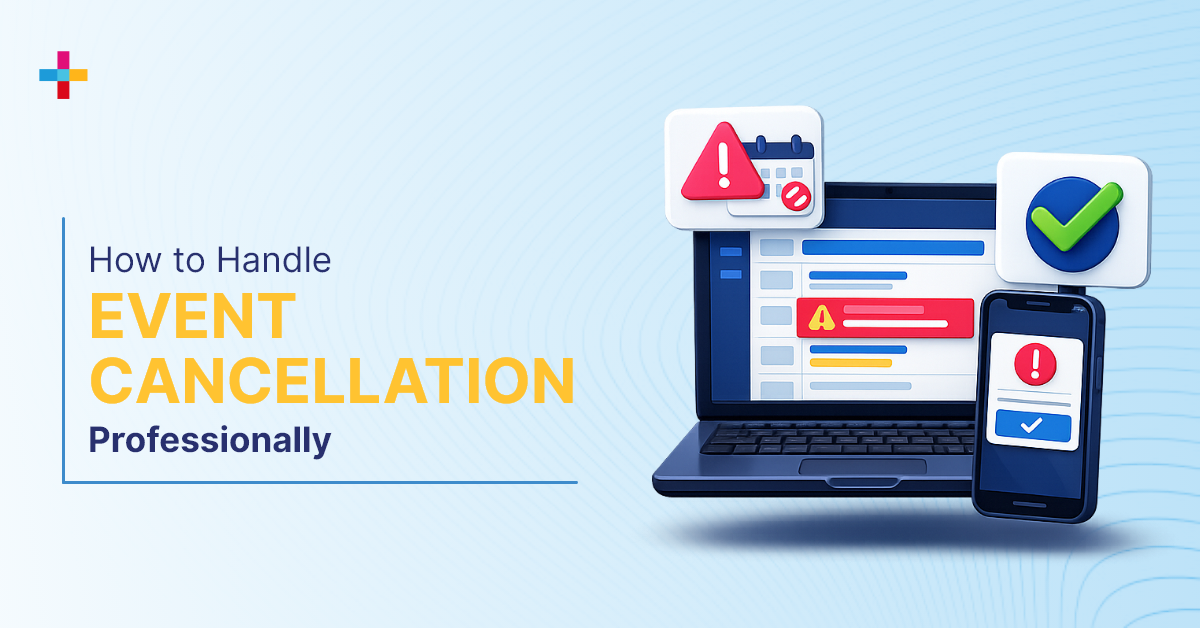

“Event canceled” is not the message any organizer wants to send or any attendee wants to receive. It is not an easy choice for any organizer, but sometimes there’s just no alternative. Unexpected situations can force an event cancellation. When it happens, the way you communicate event cancellation determines whether you stay in control or create confusion.
Today, events are high-stakes brand experiences that shape brand perception, drive business outcomes, and create value for attendees, organizers, and sponsors.
It is not easy to cancel an event. Unfortunately, if you’re navigating an event cancellation, it may introduce operational and communication pressure. So, here’s how to master event communication gracefully and professionally.
By the end of this guide, you’ll know the what, why, and how of event cancellation, communication tips, ready-to-use event cancellation templates that help maintain brand reputation and minimize negative impact on attendees.
What Is Event Cancellation Communication?
Event cancellation communication is the strategic, timely, and transparent process of informing stakeholders, attendees, and partners that a scheduled event will not occur. It requires prompt, clear messaging via email, social media, and direct updates to explain the reason, confirm refunds, and maintain professional relationships.
How to Cancel an Event Professionally
To cancel an event professionally, pause registration, align stakeholders, prepare one approved message, explain refunds or rescheduling, update all channels, and keep support ready for questions.
If you have decided to cancel your event, panic cannot shape the next step. It’s a tricky situation with multiple stakeholders, and you have to be professional, transparent, and honest to deal with it. The following are the three major steps you must follow immediately after canceling an event.
- Stop ticket sales and registration
- Align event cancellation with stakeholders
- Prepare and send the cancellation message
Tips to Send the Event Cancellation Message Effectively
Canceling a scheduled event is uncomfortable. A canceled event can frustrate even the most understanding attendee, and a disappointed attendee can affect trust, refunds, reviews, and future turnout. So, what must you do in this scenario? Be polite, positive, and communicate your event cancellation message professionally.
1. Communicate Your Event Cancellation with Empathy
You’re devastated that your scheduled event is canceled. And so are your attendees, speakers, and vendors. So, be clear, honest, and direct about the circumstances behind the decision.
Here’s a short event cancellation announcement example to let your attendees know that you empathize with them.
Subject: We’re Sorry: [Event Name] Has Been Canceled
Dear [Attendee Name],
We are truly sorry to inform you that [Event Name], scheduled for [date], has been canceled due to [brief reason].
We know this is not just a change in schedule. Many of you set aside time, made travel plans, and were looking forward to being part of this experience. We understand how disappointing this news is, and we truly regret the disruption.
This was not a decision we made lightly. We explored every possible option before arriving at this outcome, and we recognize the impact it has on everyone involved, including you.
Our immediate priority is to ensure that the next steps are clear and handled smoothly.
All registered attendees will receive [refund / credit details], which will be processed within [timeline]. No action is required from you unless otherwise communicated.
If you need any assistance or have questions, please reach out to us at [support email/contact]. Our team is here and ready to help.
We appreciate your understanding and hope to welcome you again in the future.
Sincerely,
[Your Name / Organization Name]
2. Thank Your Attendees and Supporters with Positive Messaging
Loyalty is a hard-earned treasure in the event management business. A single misstep can ruin brand reputation and lose attendance at future events. So, to avoid that outcome, let your attendees know that you appreciate their decision to support your event. Thank them for their support and share updates on future events, rescheduled dates, perks, bonuses, or discounts.
3. Communicate About Your Rescheduling Plan with Stakeholders
If circumstances allow, most event planners will avoid cancellation when a viable postponement option exists.
In such cases, share the rescheduled dates, venues, and refunds using your website. Event software like Eventcombo offers ready-to-use event website templates to build your event website and make updates in real time. It helps you to set up FAQs and share the upcoming event news.
4. Communicate Refunds Clearly
Attendees feel disheartened when they hear the news of a canceled event. Most attendees directly go to the website or app and look for the refund details. It’s up to you how intelligently you deliver your message to your attendees to show you care about them and you’re doing your best.
5. Clearly Control Internal Communications
While communicating your event cancellation, don’t forget your internal staff and teams. They should be the first to know of any canceled events. After that, keep them informed with clear and open internal messaging to mitigate rumors.
Why Event Cancellation Communication Fails
Event cancellation communication fails due to poor coordination among teams. The moment an event is canceled, multiple processes are triggered at once. Attendee communication, sponsor updates, vendor coordination, and refund handling all need to move together.
One team sends an email. Another updates the website later. Support teams are not fully briefed. Stakeholders start asking questions before answers are defined. What should have been a controlled rollout turns into fragmented communication.
This is where the breakdown begins.
1. Delayed Communication for Canceled Event
The gap between decision and communication is where confusion takes control. Attendees don’t wait. They refresh inboxes, check social feeds, and look for updates. If the update is missing, attendees fill the gap themselves. By the time official communication is sent, confusion has already spread, increasing support load and response pressure.
2. No Ownership
When no single team or individual is responsible for communication, multiple versions of the message are sent across channels. Internal teams respond differently, and stakeholders receive inconsistent information. This lack of ownership creates execution gaps, delays decision-making, and reduces accountability.
3. No Policy Clarity
When there’s no clear policy for rescheduling, refunds, and event crisis management, event cancellation communication fails. Attendees want immediate answers about events, tickets, and refunds. If policies are not defined before the event, teams provide inconsistent responses, leading to disputes and repeat inquiries from attendees and stakeholders.
What Should an Event Cancellation Policy Include?
An event cancellation policy should define refund eligibility, refund timelines, postponement terms, ticket transfer options, force majeure conditions, vendor obligations, sponsor considerations, and communication timelines.
5 Common Event Cancellation Scenarios
Unforeseen Weather and Climate Circumstances
It’s unfortunate when events are canceled due to the weather. In January 2026, many events in Nashville and Dallas were canceled or rescheduled due to winter storms.
Every plan, projection, and expected outcome including visibility, growth, and ROI are disrupted, leaving organizers managing setbacks while attendees deal with disappointment.
As an organizer, you still control how you communicate. Use channels like your website, email, or SMS to deliver clear and honest updates to your attendees.
Health and Safety Concerns
COVID-19 showed how quickly health and safety concerns can force event decisions.
You are no longer delivering an experience; you are making a judgment call on behalf of every attendee. That decision carries weight. Communication must reflect that you chose caution over convenience, acting early to prevent a situation rather than reacting to one.
Venue Failure or Issues
There are critical venue issues that could lead to cancellation, rescheduling, or attendees waiting outside with no clear explanation after the published entry time.
Before venue issues surface, everything can appear ready: plans are locked, and expectations are set. Then, there’s a message about a critical flaw like parking limitations or electrical issues that cannot be corrected in time, resulting in postponement or cancellation.
Low Registration or Ticket Sales
In-person events are costly. When insufficient registrations can’t make up for the cost, organizers cancel events, because low attendance can weaken ROI, sponsor value, and attendee experience. As an event organizer, you cannot ignore these financial constraints, which often leads to postponement or cancellation.
Absent Speaker
Despite preparing everything carefully, last-minute speaker withdrawal is heartbreaking. Health issues, travel, and logistical causes disrupt your event beyond your control. You have a limited amount of time to either replace the speaker, move forward without the speaker, postpone, cancel, or adjust the agenda if the event can still deliver value without that speaker.
Event Cancellation Email Best Practices
An event cancellation email is the first point where attendees look for clarity. It sets the tone for how all stakeholders remember the situation. Handled well, it reduces frustration. Handled poorly, it creates confusion.
The objective is simple. Deliver a clear message that answers questions before they are asked. Every element in the email should guide the reader toward understanding what happened and what to do next.
- Use clear and direct subject lines: The subject line should immediately communicate that the event is canceled. Avoid vague phrasing that forces attendees to open the email to understand the message.
- State cancellation immediately: Open with the cancellation in the first line. Do not delay or build context before stating the outcome.
- Explain the reason briefly and factually: Provide a concise explanation. Avoid over-detailing or emotional language. The goal is to inform, not justify.
- Address key attendee questions: Cover essential concerns like rescheduling plans, the refund process, timeline, and available alternatives.
- Provide a clear support contact: Include a direct channel for attendees who need further assistance. This ensures follow-up queries are handled efficiently.
- Avoid ambiguity in messaging: Each sentence should reduce uncertainty. Remove unclear or open-ended statements.
- Ensure consistency across all channels: The email, website, and event pages must reflect the same information. Consistent messaging prevents confusion and maintains trust.
Communication Channels for Event Cancellation
Event cancellation communication requires coordinated messaging across multiple channels. Each channel serves a defined role in the communication stack, and using them poorly leads to fragmented messaging, delayed response, and loss of control.
The objective is to reach registrants, speakers, and stakeholders and control the distribution of information. In the end, it is about the right message, delivered to the right audience, at the right time, through the right channel.
- Phone: Sometimes a notification is not enough to inform high-priority stakeholders about your event cancellation. Use phone calls to inform sponsors, partners, and key vendors about event cancellation before any public communication.
- Email: Email is the backbone of event cancellation communication. It provides a documented, consistent, and scalable way to reach all attendees. Through email, you can inform the attendees what happened, what it means to them, and what happens next. You can also include immediate details about refunds, rescheduling, and support.
- SMS: SMS is not designed for detail. It is designed for immediacy. Use SMS to inform attendees about last-minute or same-day cancellations. It acts as a trigger that directs users to the full message, typically via email or event platform.
- Website and social media: Your website and social media channels serve as the public layer of communication. They are not the first point of contact but become critical once the message is live. Attendees often verify information through event pages or social channels. If these platforms are not updated in sync with email communication, it creates doubt. Social media also controls public narrative. A delayed or inconsistent update allows misinformation to spread.
Event Cancellation Announcement Examples
When an event is canceled, writing the cancellation message becomes the bottleneck. Delays happen, tone becomes inconsistent, and different versions of the message start circulating.
Below are ready-to-copy event cancellation templates for common event cancellation scenarios. Each one helps you communicate immediately, clearly, and consistently. Use them to move from decision to communication without reworking the message every time.
Event Cancellation Email Template Due to Severe Weather Conditions
Here’s a ready-to-copy version of an event cancellation email template you can use to maintain attendee trust.

The following is the SMS version to announce event cancellation due to severe weather:
[Event Name] has been canceled due to severe weather. We know you planned this and truly appreciate your time and commitment. Full refunds are being processed within [timeline]. You’ll also get priority access to our next event. Check your email for full details. Thank you for your understanding.
Event Cancellation Announcement Example Due to Venue Failure
Here’s a ready-to-copy email announcement for you to deal with canceled events due to venue failure/issues.

SMS version to announce event cancellation due to venue failure:
[Event Name] will not move forward due to a critical venue issue. We chose not to proceed with a compromised experience. We know you planned for this and respect that commitment. For support or next steps, contact us at [support link/contact]. Thank you for your understanding.
Event Cancellation Email Template for Refund Communication

Here’s the SMS template to communicate refunds for events:
Refund update for [Event Name]: Full refunds are being processed to your original payment method and will be completed within [timeline]. No action is needed. We appreciate your patience. For questions, contact [support link/contact].
Event Postponement Email Template

Here’s the SMS version of event postponed message:
[Event Name] has been moved to a new date to ensure the full experience. Your ticket remains valid. If the new date doesn’t work, you can request a refund. Updates coming soon. Contact [support link] for help.
Event Cancellation Announcement for Website
Announcing an event cancellation on your website requires more than a short update. Just the announcement is not enough. Include a detailed announcement, contact form, 24/7 support number, and FAQ section answering key questions from attendees, vendors, and sponsors.
[Event Name] Cancellation Update
We regret to inform you that [Event Name] has been canceled.
This decision was made after evaluating conditions that prevent us from delivering the event at the standard it was designed for. Rather than proceeding with a compromised experience, we have chosen to stop and reassess.
We appreciate your understanding and the time you committed to this event.
What happens next
- Refunds will be processed
- Rescheduling updates will be shared
- Alternative options will be provided
Stay updated
- Recent Updates
- Upcoming Events
- Social Links
Need clarity?
FAQs
Support
Event Cancellation Announcement for Social Media
Social media announcements carry a different responsibility. This is where attendees, sponsors, and partners look for reassurance, not just updates. The social media event cancellation message must acknowledge their effort, explain the decision clearly, and show that actions are being taken with their interest in mind.
It should not feel like a broadcast. It should feel like a direct, considered update that puts your audience at the center of the decision.
[Event Name] Update
We didn’t arrive at this easily, but we need to share that [Event Name] will not go ahead.
We know this wasn’t just another event for you. You set aside time, organized plans, and expected to be part of something meaningful. That level of commitment is clear to us, and we recognize what this change disrupts.
As we reviewed the situation, it became clear that continuing would mean asking you to accept an experience that doesn’t match what we set out to deliver. That’s not something we’re willing to do.
You’ll receive details on refunds and what comes next directly. If this shift has affected your plans, we’re here and available to help.
We value the time you chose to spend with us. That matters, and it continues to guide what we do next.
Stakeholder-Based Communication Strategy
Event cancellation does not impact everyone the same way. Each stakeholder group evaluates the situation based on what the cancellation changes for them and what clarity they need next. A single message cannot address all of these perspectives.
Attendees → refunds, next steps, support access
Attendees focus on immediate impact. Their primary concern is what happens to their registration, their money, and their plans. When communicating with attendees, clearly define whether the event is rescheduled or canceled, refund timelines and methods, any alternatives and support team contact.
Sponsors → ROI recovery, brand visibility alternatives
Sponsors evaluate cancellation through the lens of return on investment. Their concern is not the event itself, but the value tied to it. Direct communication is a must with sponsors.
During event cancellation, sponsors expect information on how committed deliverables will be compensated for or replaced, future event alternatives, digital exposure, and sponsorship adjustments.
Vendors → contractual obligations, payment status
Vendors want clarity on execution, financial terms, deliverables, payments, and contractual commitments. While communicating event cancellation with vendors, clearly state remaining obligations, payment status and timelines, and next steps to avoid friction and potential disputes.
Internal teams → execution roles, escalation flow
Internal teams will execute this communication and manage the fallout. Without a clear direction, honest reasons, and approved narrative, your team messaging may become inconsistent.
Define internal teams' roles and responsibilities, approved messages and templates, and escalation paths for unresolved issues.
Media → consistent public narrative
Media shapes perception quickly. Maintain control with a clear public statement, aligned messaging across channels, and no speculation. If communication is delayed or inconsistent, external narratives take over.
Conclusion: Canceling an Event Isn’t Easy
Canceling an event is never a simple decision. It carries financial impact, stakeholder expectations, and the pressure of maintaining trust. Even with careful planning, some variables that can disrupt an organized event remain outside your control. At that point, the focus must shift from execution to response.
What remains within control is how the situation is handled. Clear and consistent messaging with well-defined next steps not only reduces confusion around the cancellation but keeps brand reputation intact among attendees, sponsors, and partners. They may have wanted the event, but in cancellation, they expect clarity, responsibility, and follow-through. In the end, a well-handled cancellation does not protect the event. It protects relationships.