F216
F216

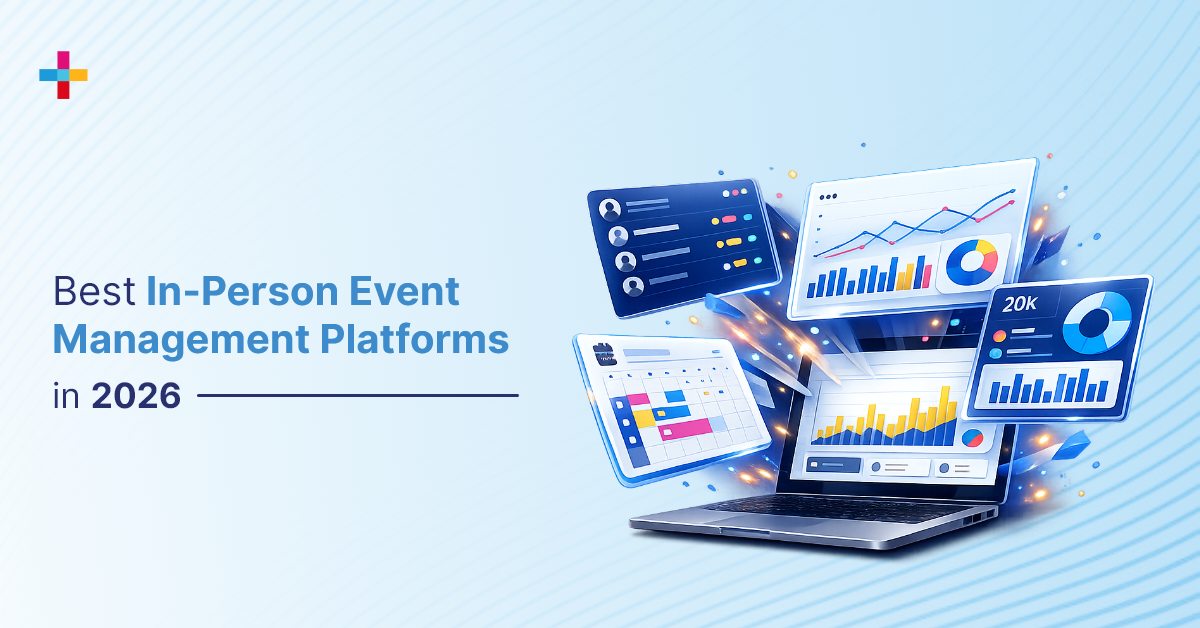

In-person event management platforms have evolved into core operational systems for modern events. Organizations are prioritizing attendee experiences because physical events deliver stronger engagement, higher conversion, and measurable business outcomes that digital channels alone cannot replicate.
However, executing a successful event is operationally complex. Teams must manage registration, event check-in software, onsite event technology, attendee movement, and real-time engagement without breakdowns. When these workflows are handled across disconnected tools, execution slows and data becomes unreliable.
That is where a structured in-person event management platform becomes critical. These platforms consolidate registration, check-in, engagement tracking, and reporting into a single system, enabling faster execution and consistent data flow.
This guide analyzes the top in-person event management platforms in 2026, including Eventcombo, Bizzabo, vFairs, Whova, and Cvent based on their ability to support operational control, scalability, and data continuity.
Top Platforms at a Glance
- Eventcombo → Unified platform for managing registration, onsite execution, and reporting
- Bizzabo → Engagement-focused platform for networking and audience interaction
- Cvent → Platform focused on venue sourcing and large-scale event logistics
- Whova → Platform designed for community engagement and attendee interaction
- vFairs → Platform built for hybrid and expo-style event experiences
What is the Best In-Person Event Management Platform?
There is no single best in-person event management platform. The right choice depends on event scale, operational complexity, and how data is managed across registration, check-in, and onsite workflows. Platforms like Eventcombo, Cvent, and Bizzabo are commonly used, but selection should be based on whether teams need enterprise control, flexibility, or a unified system for execution and reporting.
What to Look for in an In-Person Event Management Platform
- Check-in performance: The platform must sustain high-throughput entry under peak conditions with rapid scan rates. Slow or unstable check-in creates queue buildup, delays session starts, and impacts overall event flow.
- Registration flexibility: A structured event registration platform should support multiple ticket types, conditional logic, and attendee segmentation. Limited flexibility restricts data capture and reduces the ability to manage different attendee groups effectively.
- Data accuracy: Registration, check-in, and onsite engagement data must operate on a single data layer. When systems are disconnected, records become inconsistent, requiring manual correction and reducing reporting reliability.
- Engagement tracking: The system should capture session attendance, participation signals, and interaction data in real time. Without this, teams lack visibility into attendee behavior and cannot measure engagement outcomes.
- Reporting: Post-event analytics must be generated directly from the platform without manual data consolidation. Disjointed reporting workflows slow down analysis and weaken decision-making accuracy.
- Offline capability: The platform must support attendee check-in without internet connectivity and sync data once reconnected. Without this, entry operations stall in low-connectivity environments, increasing wait times and operational risk.
- Integration ecosystem: The platform should integrate with CRM, marketing automation, and payment systems. Limited integrations create data silos, require manual transfers, and reduce end-to-end visibility across the event lifecycle.
Comparison of Top In-Person Event Platforms
|
In-Person Event Management Platform |
Key Strengths |
Limitations |
Best For |
Pricing |
User Reviews |
|
1. Eventcombo |
Unified platform across registration, check-in, and reporting |
Lower legacy enterprise brand visibility |
Teams needing centralized execution and real-time data continuity |
Custom pricing based on scale and modules |
Strong feedback on usability, support, and all-in-one capabilities |
|
2. InEvent |
Customization and branding control |
Requires integrations for full ticketing and workflows |
Corporate events with strict branding requirements |
Tiered pricing with add-ons |
Positive for flexibility, noted dependency on integrations |
|
3. Bizzabo |
Engagement and audience segmentation |
Limited flexibility in registration architecture |
Conferences and networking-driven events |
Enterprise pricing model |
Strong engagement tools, mixed feedback on customization |
|
4. Cvent |
Enterprise-grade logistics and venue sourcing |
Complex interface and higher cost structure |
Large-scale corporate and government events |
Subscription + per-registration pricing |
Reliable but requires onboarding and training |
|
5. Whova |
Easy-to-use interface with strong attendee app |
Limited scalability for complex operations |
Small to mid-sized events and workshops |
Subscription-based pricing |
User-friendly, limited advanced capabilities |
|
6. vFairs |
Strong hybrid and exhibitor management capabilities |
UI limitations in some workflows |
Trade shows and hybrid events |
Custom pricing based on event type |
Effective for expos, mixed usability feedback |
|
7. EventMobi |
Mobile-first event app and engagement tools |
Limited depth in backend operational workflows |
Conferences prioritizing attendee experience |
Tiered pricing based on features |
Strong app experience, moderate backend flexibility |
|
8. Airmeet |
Community and networking-focused engagement |
Limited onsite operational control for in-person events |
Hybrid and community-driven events |
Subscription-based pricing |
Strong networking features, less robust onsite capabilities |
|
9. Eventbrite |
Simple and fast event registration platform |
Limited onsite control and fragmented data workflows |
Small events and ticketing-focused use cases |
Per-ticket service fees |
Easy to deploy, limited scalability for complex events |
|
10. Accelevents |
Flexible event setup with hybrid support |
Interface complexity in advanced workflows |
Mid-sized events needing hybrid flexibility |
Tiered pricing plans |
Good feature set, usability varies by use case |
|
11. RingCentral Events |
Integrated virtual and hybrid event environment |
Less focus on onsite execution infrastructure |
Virtual-first and hybrid events |
Subscription pricing |
Strong for virtual delivery, limited onsite depth |
|
12. Sched |
Agenda and session scheduling management |
Limited registration and check-in capabilities |
Events focused on session management |
Subscription pricing |
Easy scheduling, lacks full event system coverage |
|
13. PheedLoop |
Customization and exhibitor management tools |
Requires configuration for full operational flow |
Trade shows and academic conferences |
Modular pricing structure |
Flexible but setup complexity noted |
Best Event Management Platforms by Use Case
- Large-scale conferences with high attendee volume and complex logistics → Eventcombo, Bizzabo
- Enterprise environments requiring structured workflows and compliance → Eventcombo, Cvent
- Hybrid scalability across in-person and digital events → RingCentral Events, Eventcombo
- Community-driven events → Whova
- Trade shows and exhibitor-heavy events → Eventcombo, vFairs
Top 13 In-Person Event Management Platforms
1. Eventcombo
Eventcombo is a system-first in-person event management platform that replaces fragmented tools with a unified operational infrastructure. What differentiates it from other platforms is that instead of treating registration, event check-in software, onsite execution, and reporting as separate layers, usually termed and charged as add-ons, it connects every single feature through a single data architecture, ensuring continuity from pre-event setup to post-event analysis.
This unified approach aligns with how enterprise event teams now operate in 2026, where real-time data access, system interoperability, and execution control are non-negotiable. By maintaining one source of truth across attendee data, session tracking, and engagement signals, Eventcombo focuses on reducing reconciliation effort, improving reporting accuracy, and enabling faster decision-making, even during live events.
Eventcombo is positioned around operational resilience. Features such as offline check-in, real-time syncing, and integrated workflows ensure that execution does not depend on external tools or an unstable internet connection. The result is a controlled environment where teams can manage high-volume events with top-notch performance and measurable outcomes.
Key Features
- Integrated event registration platform: Supports flexible ticketing, conditional logic, and structured data capture. This ensures attendee data is collected in a standardized format and flows directly into onsite operations without duplication or manual cleanup.
- Real-time event check-in software: Enables fast QR-based check-in with on-demand badge printing. This reduces entry bottlenecks and ensures accurate attendance tracking from the moment attendees arrive.
- Mobile organizer app: Provides onsite control through a centralized interface for check-in, tracking, and session monitoring. Teams can manage operations in real time without relying on multiple tools or manual coordination.
- Venue and resource management: Centralizes control of spaces, vendors, and equipment within a single dashboard. This improves allocation accuracy and reduces coordination gaps across logistics workflows.
- Live reporting and analytics: Captures attendee behavior, session data, and engagement metrics in real time. This allows teams to make operational decisions during the event and generate post-event insights without manual consolidation.
- Integration ecosystem: Connects with CRM, marketing automation, and payment systems. This ensures consistent data flow across systems, eliminates silos, and reduces reconciliation effort.
- Onsite support and staffing: Provides operational support for check-in, logistics, and technical troubleshooting. This stabilizes execution and reduces risk during high-volume or complex events.
Where It Works Well
Eventcombo works well for teams that need a single system to manage registration, onsite execution, and reporting without relying on disconnected tools. In environments where multiple workflows must operate in sync, Eventcombo prioritizes data accuracy, operational efficiency, and scalable event infrastructure.
Large conferences, multi-track events, and complex IRL events benefit the most from its centralized system that maintains data consistency while aligning with global security standards.
2. InEvent
InEvent offers strong brand control across attendee touchpoints. It prioritizes visual consistency and workflow configuration for delivering tailored event experiences.
Key Features
- Customizable registration flows and branded event pages with flexible design control
- Workflow automation for communications, approvals, and attendee management
- Integration capabilities with CRM and marketing systems to extend functionality
- Tools for managing both in-person and hybrid event formats
Limitations
The core limitation of InEvent is that operational workflows such as ticketing and data synchronization depend on integrations. This creates fragmented data, increases setup complexity, and impacts real-time execution reliability.
3. Bizzabo
Bizzabo is an engagement-driven event management platform that delivers personalized attendee experiences. It is widely adopted for conferences where networking, audience segmentation, and interaction design are central to event outcomes.
Key Features
- Advanced audience segmentation to tailor agendas and communications
- Networking tools including meeting scheduling and attendee matchmaking
- Onsite engagement technology such as check-in kiosks and interaction tracking
- Analytics focused on attendee behavior, session performance, and engagement metrics
Limitations
Registration and backend workflow control are more constrained compared to system-first platforms. These limit multi-layered events teams to structure data capture and operational processes.
4. Cvent
An enterprise-grade in-person event management platform powers large-scale and complex event operations. It’s known for venue sourcing and managing high-volume attendee logistics.
Key Features
- Integrated venue sourcing marketplace with global supplier access
- Onsite event technology including check-in, badging, and tracking
- Budgeting, compliance, and logistics management tools for enterprise workflows
- Reporting capabilities aligned with corporate governance and performance tracking
Limitations
System complexity increases onboarding time and operational overhead. Pricing structures and per-registration costs can scale significantly, and workflows may require training to manage effectively across teams.
5. Whova
Whova is a mobile-first event management platform that focuses on attendee experience and ease of use. It is used for smaller to mid-sized events where networking, session interaction, and community participation are primary objectives.
Key Features
- Event app with agenda management, networking, and messaging
- Basic event check-in app with QR-based attendee validation
- Community boards and interaction tools to drive attendee participation
- Survey and feedback collection for post-event insights
Limitations
Limited depth in backend operational workflows such as complex registration logic, multi-layered data management, and large-scale event control.
6. vFairs
This hybrid-first event management platform is known for trade shows and expos that require coordinated delivery across virtual and physical environments. It is used for managing exhibitor-heavy events with structured digital and onsite components.
Key Features
- Exhibitor and sponsor management with booth configuration and asset control
- Virtual environment capabilities combined with onsite event technology
- Onsite kiosks and mobile tools for attendee navigation and check-in
- Engagement features including chat, sessions, and content access across formats
Limitations
User interface and workflow flexibility are restrictive, particularly for teams needing rapid updates or highly customized operational flows. Data and reporting across virtual and onsite components require additional configuration.
7. EventMobi
EventMobi is a mobile-first event management platform centered on attendee experience and engagement. It is known for conferences where the event app serves as the primary interface for schedules, communication, and interaction.
Key Features
- Branded event app with agenda management, push notifications, and networking
- Session engagement tools including polling, Q&A, and feedback collection
- Basic registration and check-in capabilities integrated with the app
- Content management for speakers, sponsors, and session materials
Limitations
Backend operational depth is limited compared to system-first platforms. Complex registration workflows, real-time data synchronization, and large-scale onsite execution may require additional tools or integrations.
8. Airmeet
Airmeet is a networking-first layer within the in-person event management platform space. It focuses on attendee interaction and community engagement, with limited depth in event check-in software and onsite event technology.
Key Features
- Social lounges and networking tables to facilitate real-time attendee interaction
- Session formats with chat, Q&A, and audience engagement tools
- Community-building features such as attendee profiles and ongoing interaction spaces
- Integration capabilities with CRM and marketing systems for extended workflows
Limitations
Onsite event operations such as check-in, badging, and physical logistics are not deeply developed. For in-person events, teams may require additional configuration to manage execution and maintain data consistency.
9. Eventbrite
Eventbrite operates mainly as an event registration platform rather than a full in-person event management platform. It is built for fast setup, with basic event check-in software and minimal onsite event technology.
Key Features
- Quick event setup with standardized ticketing and payment processing
- Built-in event discovery and distribution through its marketplace
- Basic attendee management and QR-based check-in functionality
- Simple reporting for ticket sales and attendance tracking
Limitations
It has limited capability in onsite event technology, advanced registration logic, and real-time data synchronization.
10. Accelevents
Accelevents is a flexible in-person event management platform that supports multiple event formats. It offers configurable event registration platform workflows, while onsite event technology depends on setup.
Key Features
- Configurable event registration platform with ticketing and attendee management
- Support for hybrid and virtual event delivery alongside onsite operations
- Engagement tools including chat, polling, and session interaction
- Basic reporting and analytics for tracking attendance and engagement
Limitations
As configuration depth increases, usability and workflow clarity can become challenging. Real-time onsite execution and data synchronization may require additional setup.
11. RingCentral Events
RingCentral Events is a virtual-first platform extending into the in-person event management platform category. Its primary strength is digital delivery, with limited focus on event check-in software and onsite event technology.
Key Features
- Scalable virtual event infrastructure supporting multi-session broadcasts and large audiences
- Built-in streaming, session management, and audience engagement tools
- Registration and ticketing capabilities integrated with virtual delivery
- Analytics focused on attendance, session views, and engagement metrics
Limitations
Onsite event technology such as check-in, badging, and physical logistics management is limited.
12. Sched
Sched is a scheduling layer used alongside an in-person event management platform. It manages agendas but relies on external event registration platform tools and event check-in software.
Key Features
- Agenda and session scheduling with track and room management
- Speaker and content management for sessions and presentations
- Attendee-facing schedules with personalization options
- Basic integrations with registration and event management tools
Limitations
Limited capability in core event operations such as registration, event check-in software, and real-time onsite management.
13. PheedLoop
PheedLoop is a configurable in-person event management platform with structured control across registration and onsite operations. It supports advanced event registration platform workflows and integrated event check-in software.
Key Features
- Customizable event registration platform with advanced form logic and pricing structures
- Exhibitor and sponsor management with booth assignments and asset tracking
- Onsite event technology including check-in, badge printing, and session tracking
- Modular reporting and analytics with configurable data views
Limitations
Setup and configuration require significant time and operational expertise. Without proper structuring, workflows can become complex, and teams may face longer onboarding cycles compared to more streamlined platforms.
How to Choose an Event Management Platform
- Test check-in speed: Simulate peak entry conditions using real attendee volumes. Measure scan rate, queue time, and system latency to confirm the platform can maintain throughput without delays or failure points.
- Validate attendee data access onsite: Ensure registration data, ticket status, and session access are available in real time across all devices. Lack of synchronization leads to manual overrides and inconsistent attendee records.
- Review reporting workflow: Evaluate how quickly the platform generates post-event reports without manual data consolidation. Systems that require exports and merging reduce reporting accuracy and delay decision-making.
- Assess scalability across events: Confirm the platform supports repeatable workflows, multi-event management, and consistent data structures. Without scalability, teams recreate processes for each event, increasing operational overhead and risk.
Conclusion
In-person events don’t break because teams lack features. They break when systems don’t connect.
When registration, event check-in software, and onsite operations run on separate tools, execution becomes reactive. Lines build at entry points, staff shift to manual workarounds, and reporting turns into reconciliation instead of real insight. This is where platforms like Eventcombo change the operating model by keeping these workflows inside a single system, so data moves without disruption.
A structured in-person event management platform creates continuity across the event lifecycle. Attendee data flows from registration to check-in to engagement tracking without fragmentation. With Eventcombo, that continuity translates into faster entry, stable onsite execution, and reporting that reflects actual event performance, not stitched datasets.
Choosing a platform is not about feature depth. It is about whether the system can maintain control under live conditions and produce reliable data outcomes.
If your current setup requires multiple tools to run a single event, the issue is structural. Book a demo with Eventcombo to see how unified execution changes event performance.