F216
F216

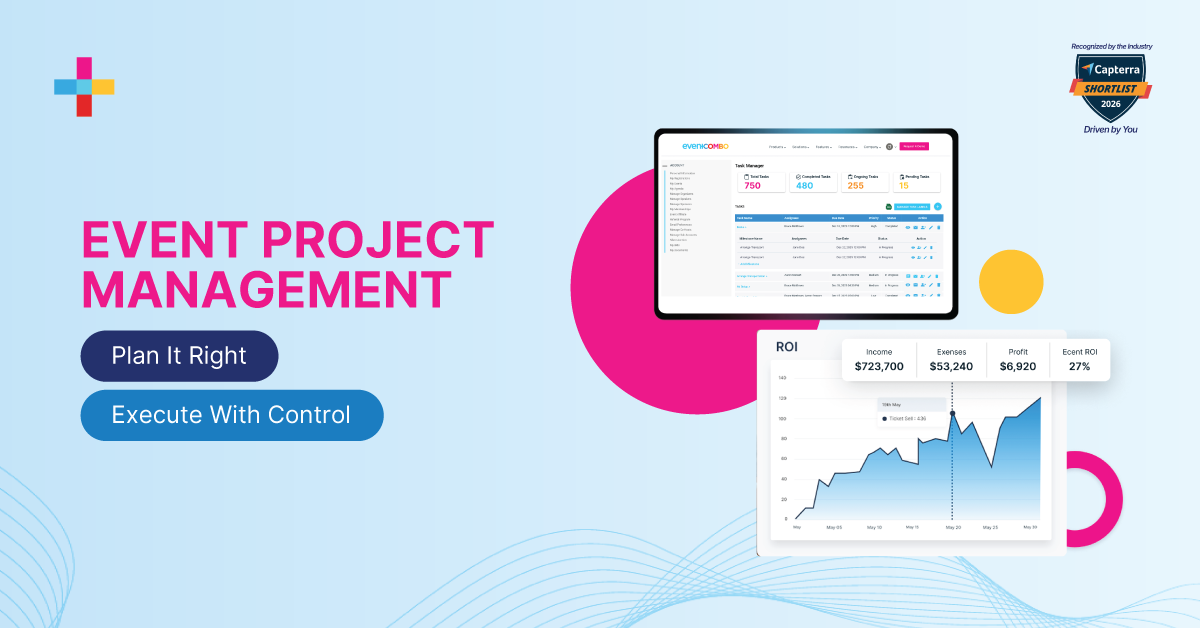

Event project management keeps your event on track when timelines tighten, approvals slow down, and vendors miss handoffs. You work against fixed dates. Once doors open, you cannot pause and fix what broke.
You control that risk by defining scope early, assigning ownership clearly, and mapping dependencies before execution begins. Structure protects your budget, your schedule, and your attendee experience.
In this guide, you will learn what event project management is, how to build an effective event project management plan, the key steps across the event lifecycle, and the metrics planners use to measure execution success.
What Is Event Project Management
Event project management is the structured application of project management principles to planning and executing events with fixed deadlines. Unlike long-term initiatives, events do not allow extended iteration or phased recovery. Planning and execution move within a compressed timeline, and every decision must account for it.
At a functional level, event project management establishes how work moves from concept to execution. It defines how decisions are made, who owns them, and how changes are evaluated once planning begins. This structure allows teams to manage complexity without slowing progress.
In practice, effective event project management depends on:
• Defined scope of boundaries that prevent informal additions without evaluation.
• Sequenced task dependencies that reflect how work actually unfolds across logistics, content, marketing, and technology.
• Explicit ownership models that eliminate ambiguity between internal teams, stakeholders, and vendors.
• Ongoing performance tracking that identifies deviations early enough to correct them without disruption.
What distinguishes event project management is control over trade-offs. Time, budget, and experience cannot flex simultaneously. Constraints are inevitable. The difference lies in how teams decide, document, and protect core event outcomes. Understanding the mechanics of event project management matters even more in today’s evolving event environment.
Why Is Event Project Management Important for Modern Events?
Event project management is important because modern events operate under higher scrutiny, tighter timelines, and direct business accountability. Expectations have increased, and outcomes now tie closely to measurable performance rather than subjective experience.
Business Impact
Organizations evaluate events on tangible outcomes. Leadership expects alignment between event activity and business goals such as pipeline contribution, partner enablement, or internal adoption. Event project management creates the structure needed to define these objectives early and track performance across the event lifecycle. That visibility allows teams to justify investment with data rather than assumptions.
Audience Expectations
Attendees expect reliability across every touchpoint. Registration must move quickly. Sessions must start on time. Navigation must feel intuitive. Everyday digital experiences shape these attendee expectations and reduce tolerance for friction. Event project management ensures that event experience standards translate into operational requirements and remain consistent under live conditions.
Revenue Pressure
Sponsors and partners expect clear value delivery. Sponsors track booth traffic, session attendance, lead quality, and contracted visibility commitments. Event project management provides the framework to plan, monitor, and validate these deliverables. When revenue ties directly to performance, disciplined execution protects credibility and long-term renewals.
To apply event project management effectively, planners must understand how it differs from traditional event planning and how the two work together.
What Is the Difference Between Event Project Management and Event Planning?
Event planning and event project management serve different purposes within the same event lifecycle. Both are essential, but they operate with different objectives and decision frameworks.
Event planning concentrates on the attendee-facing experience. It shapes agendas, session flow, environments, branding, and engagement touchpoints. The focus is qualitative. It determines how the event feels, how content flows, and how attendees interact with the experience.
Event project management focuses on delivery control. It governs how experience decisions are executed within defined constraints of scope, time, and cost. The focus is operational. It determines how work is sequenced, who owns it, and how teams respond when conditions change.
It translates planning intent into executable reality. It ensures that creative and experiential decisions align with logistical feasibility and available resources.
In practice, event project management strengthens execution in three critical areas:
- Dependency Mapping Between Experience and Operations
Creative decisions such as session formats, stage design, or networking layouts are evaluated against venue access, production schedules, staffing needs, and technology setup. - Risk Analysis Tied to Execution Outcomes
Risks are assessed based on their impact during live delivery, including crowd flow, speaker readiness, technical reliability, and sponsor commitments. - Formal Change Control for Experience-Driven Requests
When experience changes affect budget, timeline, or vendor scope, they are reviewed for impact before approval rather than absorbed informally.
Strong event teams integrate both by design. Experience design informs planning, and event project management governs execution. Creative ideas move forward only after timelines, budgets, and operational capacity are validated. This integration reduces late-stage rework and protects the attendee experience when pressure is highest. Clear separation between these roles allows teams to operate with greater precision.
Essential Event Project Management Terms and Definitions
Event project management relies on shared definitions to function smoothly. These terms appear across timelines, task lists, status meetings, and vendor communications. Clear understanding prevents delays and misalignment when execution pressure increases.
1. Work Breakdown Structure (WBS)
A Work Breakdown Structure is a hierarchical breakdown of the event into smaller, manageable components. It defines what work exists and how it is organized. Each element includes a clear output, owner, and level of responsibility.
2. RACI Matrix (Responsible, Accountable, Consulted, Informed)
A RACI matrix defines roles for each task. Responsible completes the work. Accountable owns the outcome. Consulted provides input. Informed receives updates. Event project management uses RACI to eliminate ownership confusion and accelerate decision-making.
3. Critical Path
The critical path is the longest sequence of dependent tasks that determines the shortest possible completion time for the event. Any delay along this path delays the event itself. It identifies tasks that require the highest level of monitoring.
4. Milestone
A milestone is a significant checkpoint that indicates progress, such as venue confirmation or agenda approval. It marks readiness, not task completion.
5. Deliverable
A deliverable is a tangible output required to move the event forward, such as a finalized floor plan, speaker contract, or production schedule.
6. Scope
Scope defines the approved work included in the event. It establishes boundaries and prevents unplanned additions from entering the plan without formal review.
7. Change Request
A change request is a formal proposal to modify scope, timeline, or budget. It triggers structured impact analysis before approval.
8. Risk Register
A risk register is a documented list of potential issues ranked by likelihood and impact. Teams use it to plan mitigation strategies before execution begins.
9. Issue Log
An issue log tracks active problems that require immediate resolution. Teams rely on it most heavily during execution.
10. Dependencies
Dependencies define relationships between tasks where one must start or finish before another can proceed. They ensure work is sequenced accurately.
11. Stakeholder
A stakeholder is any individual or group with influence over or interest in the event’s outcomes, such as sponsors, executives, partners, or clients.
12. Vendor
A vendor is an external service provider responsible for delivering specific contracted outputs but not owning overall event success.
13. Key Performance Indicators (KPIs)
Key Performance Indicators are measurable metrics used to evaluate event performance, such as attendance numbers, budget variance, sponsor engagement, or session participation rates.
With a common language established, planners can apply event project management consistently across each phase of the event lifecycle.
Event Project Management Steps Across the Event Lifecycle
Event project management follows a defined lifecycle because events compound risk as they move forward. Early decisions limit later flexibility. Missed work does not disappear. It resurfaces during execution, where corrections cost more and attract more visibility. Each phase exists to manage risk at the point where it is easiest to control.
The Five Core Event Project Management Steps
- Initiation: Define purpose, scope, authority, and feasibility
- Planning: Structure tasks, dependencies, risk, and resources
- Execution: Deliver under live conditions with controlled decision-making
- Monitoring: Track budget, schedule, and operational indicators in real time
- Closure: Evaluate results and capture institutional knowledge
Step 1: Initiation
Initiation defines the event before momentum makes change difficult.
- Objectives and Authority: This phase clarifies why the event exists, how success will be measured, and who has final decision authority. Objectives must be operational, not aspirational. Attendance targets, revenue goals, sponsor commitments, and experience outcomes should be measurable and prioritized.
- Budget Alignment: Budget approval establishes financial boundaries for the entire project. It sets not only the spending ceiling but also how variance will be handled. Contingency usage, approval thresholds, and trade-off rules are defined here, not during execution.
- Format and Scale Decisions: Choices such as in-person, hybrid, or multi-day formats affect staffing, production, technology, and risk exposure. Teams must acknowledge these structural implications before planning begins.
- Feasibility Validation: Venue availability, market demand, speaker access, staffing capacity, and timeline constraints must be tested against objectives. When teams assume feasibility instead of validating it, they compensate later with unrealistic schedules and compressed execution.
Step 2: Planning
Planning converts intent into a system that can withstand pressure.
- Dependency Mapping: Work is structured around task relationships rather than isolated categories. Registration depends on pricing approval. Marketing depends on messaging alignment. Production depends on venue access. Planning makes these relationships visible.
- Schedule Structuring: Timelines reflect decision deadlines, approval cycles, review buffers, and vendor lead times. A realistic schedule mirrors how work actually moves through the organization.
- Risk Definition: Each identified risk includes a trigger, an owner, and a mitigation action. High-impact risks receive predefined responses so teams do not invent solutions during live execution.
- Resource Allocation: Staffing plans account for peak arrival waves, session transitions, and teardown intensity. Planning for peaks prevents breakdown during high-traffic moments.
- Contingency Preparation: Backup speakers, alternate layouts, secondary vendors, and technology failover options are documented with clear activation criteria. Defined contingency plans allow immediate action without debate. Planning builds readiness. If execution feels chaotic, planning was incomplete.
Step3: Execution
Execution tests the structure under live conditions.
- Decision Speed and Authority: Daily coordination focuses on what has changed, what is at risk, and what decisions must happen next. Teams exercise authority established during initiation instead of reopening debates.
- Change Control: Scope adjustments, sponsor requests, and experience modifications are evaluated for operational impact before approval. This prevents isolated decisions from disrupting downstream work.
- Real-Time Documentation: Teams document decisions, deviations, and resolutions while context remains fresh. Clear records support accountability and prevent post-event disputes.
Step 4: Monitoring
Monitoring keeps execution aligned with plan as conditions evolve.
- Cost Tracking: Teams track financial commitments in real time, including purchase orders, change requests, and vendor adjustments. Monitoring commitments prevents unexpected budget drift.
- Schedule Signals: Missed approvals, delayed inputs, and vendor hesitation act as early warning indicators. Identifying signals early prevents cascading delays.
- Operational Metrics: Registration volume, check-in throughput, session attendance, and staffing load guide real-time adjustments. Continuous visibility keeps responses coordinated rather than reactive.
Step 5: Closure
Closure captures value beyond the event itself.
- Financial Reconciliation: Teams verify final budget accuracy and document variance drivers for future forecasting.
- Vendor Evaluation: Vendor performance is assessed against contractual commitments and execution quality.
- Post-Event Analysis: Attendance, engagement, revenue impact, and experience metrics are reviewed alongside execution decisions. Assets such as floor plans, timelines, and templates are archived with context for reuse.
Closure preserves institutional knowledge. Without it, organizations repeat patterns instead of improving performance. Even with a defined lifecycle, recurring execution pressure exposes predictable challenges that structured event project management must address directly.
Real-World Execution Gaps That Derail Event Project Management
Even with a defined lifecycle, events break down in predictable ways. Most failures do not come from bad ideas. They come from blind spots in ownership, visibility, timing, and coordination.
1. Parallel Spending Without Central Visibility
Production adds a lighting upgrade. Marketing increases print runs. Sponsorship promises additional signage. Each decision seems contained, but together they shift the budget. Without centralized tracking of committed spend, teams discover variance after contracts are signed.
2. Incremental Changes That Reshape the Event
A 45-minute session becomes 60 minutes. A sponsor adds a private reception. A networking area expands. Each change affects staffing, AV labor, room turnover, security, and flow. When teams treat changes as isolated requests instead of structural shifts, downstream strain compounds.
3. Load-In Assumptions That Do Not Match Reality
Production assumes early access. Decor expects freight elevator priority. Badge printers depend on final data imports. When vendor timelines overlap without alignment, rehearsal windows shrink and problem-solving happens under time pressure.
4. Fragmented Systems and Delayed Data
Registration lives in one platform. Badge printing in another. Sponsor lead retrieval in other. Finance tracks contracts separately. When systems do not sync, teams rely on manual exports and reconciliation. Eventcombo is one of the best event platforms that address fragmented system gaps by unifying registration and check-in data into a single source of truth. This eliminates the delay that often hides real-time registration trends, check-in flow projections, and revenue commitments until it is too late to adjust.
5. Approval Delays That Compress Execution Windows
Executive sign-off on budgets, speakers, or floor plans often arrives later than planned. Marketing holds campaigns. Production holds orders. As deadlines approach, teams compress execution into shorter windows, increasing error rates and labor costs.
6. Ownership Confusion Under Pressure
Multiple teams collaborate on content, sponsorship, and operations. When issues arise onsite, unclear accountability slows response. Teams debate responsibility instead of resolving the problem. Defined ownership matters most when decisions must happen quickly.
7. Peak Traffic Underestimation
Registration surges during specific arrival windows. Popular sessions exceed projected attendance. Networking spaces fill faster than modeled. When teams plan for averages instead of peaks, bottlenecks crop up in places like check-in lines, session rooms, and crowd flow.
8. Temporary Staff Without Clear Escalation Paths
Volunteers and temporary staff often receive high-level instructions but lack decision authority. When unexpected issues arise, they escalate slowly or inconsistently. Without clear task management software, even small operational problems expand unnecessarily.
Structured event project management addresses these gaps by defining ownership, centralizing visibility, validating assumptions early, and controlling change before it compounds.
How to Strengthen Event Project Management Under Real-World Pressure
Strong event project management does not rely on more effort. It relies on tighter systems that eliminate blind spots before they compound.
1. Centralize Financial Commitments: Parallel spending becomes risky when teams track budgets in isolation. A single financial view of signed contracts, pending approvals, and projected spend prevents surprise overruns. Real-time commitment tracking allows adjustments before vendor invoices arrive.
2. Treat Change as Structural, Not Isolated: Session extensions, sponsor add-ons, and layout changes affect multiple teams. Instead of approving requests in isolation, route them through impact review that includes production, staffing, space allocation, and cost implications. Small shifts stay small when downstream effects are visible early.
3. Align Vendor Timelines Before Load-In
Vendor friction often begins weeks before the event. Confirm venue access windows, freight schedules, data transfer deadlines, and rehearsal blocks in writing. Shared timelines reduce last-minute compression and protect setup windows.
4. Unify Registration, Check-In, and Capacity Data
Disconnected systems delay insight. A connected infrastructure for registration and check-in surfaces attendance patterns, arrival waves, and session capacity risks early. Real-time throughput data allows staffing adjustments before lines form.
5. Build Approval Windows Into the Schedule
Approval delays are predictable. Account for executive and sponsor review cycles directly in the timeline. When approvals slip, downstream teams adjust proactively instead of compressing execution.
6. Assign Decision Authority Before Doors Open
Ownership confusion surfaces under live pressure. Define who can approve budget shifts, room changes, sponsor accommodations, and staffing adjustments before the event begins. Clear authority prevents debate during critical moments.
7. Plan for Peak Demand, Not Averages
Arrival surges, breakout transitions, and networking intervals create traffic spikes. Model staffing and space for peak volume rather than projected averages. This reduces registration bottlenecks and room capacity strain.
8. Equip Temporary Staff With Escalation Clarity
Volunteers and temporary crew need more than instructions. Provide clear escalation chains and decision boundaries. When frontline teams know where to route issues, minor disruptions resolve quickly.
9. Maintain Integrated Operational Visibility
Financial data, attendance numbers, session performance, and sponsor delivery metrics should be visible in one operational view. When teams see performance indicators together, they act with context rather than assumption.
10. Pre-Approve Contingency Triggers
Backup speakers, alternate layouts, and secondary vendors should not require debate under pressure. Define activation thresholds in advance. When a trigger occurs, action follows automatically.
Effective event project management replaces reactive coordination with structured visibility and defined response mechanisms. The goal is not more control for its own sake. The goal is fewer surprises under live conditions.
Key Metrics That Indicate Event Project Management Is Working
Event project management is not measured by effort. It is measured by control, predictability, and outcome alignment. The following indicators reveal whether execution systems are working as designed.
1. Budget Variance at Commitment Stage
Track variance when commitments are made, not after invoices arrive. Compare approved budget against signed contracts and pending change requests. If variance appears late, financial visibility is lagging.
2. Milestone Reliability Rate
Measure how often critical checkpoints are met on schedule. Content lock, floor plan approval, sponsor asset submission, and production readiness dates signal execution health. Repeated slippage indicates upstream planning gaps.
3. Change Impact Frequency
Monitor how often approved changes trigger downstream adjustments in staffing, space allocation, or cost. High ripple effects suggest weak impact review processes.
4. Registration Trend Accuracy
Compare projected attendance curves against actual registration velocity. Significant deviation signals demand forecasting gaps and potential onsite strain.
5. Check-In Throughput
Measure badge printing speed, queue time, and peak-hour processing volume. Throughput performance reflects planning accuracy for staffing and arrival modeling.
6. Session Capacity Utilization
Track actual room occupancy against projected attendance. Overflows and underfilled rooms reveal weaknesses in demand forecasting and space planning.
7. Sponsor Delivery Fulfillment
Audit contracted sponsor commitments against actual execution. Booth placement, lead capture, speaking slots, and branding visibility should match agreements. Consistent variance damages renewal confidence.
8. Issue Resolution Time
Measure how quickly onsite issues move from identification to resolution. Slow resolution often points to unclear escalation paths or fragmented communication.
9. Post-Event Budget Reconciliation Accuracy
Evaluate final variance drivers against forecast assumptions. If recurring surprises appear across events, estimation models require refinement.
10. Repeatability Indicators
Assess how much of the project framework can be reused without redesign. Standardized templates, archived floor plans, and documented workflows reduce rebuild effort and signal structural maturity.
Strong event project management creates predictable patterns across these metrics. When deviations appear early and corrections happen quickly, execution remains controlled. When metrics surface only after impact, systems require tightening.
When You Need a Structured Event Project Management Framework
Informal coordination works for small, low-risk events. It breaks down when complexity increases. The following conditions signal that a structured event project management framework is necessary:
• Multiple vendors operate on interdependent delivery timelines.
• Stakeholder and sponsor requests accelerate close to the event date.
• Budget scrutiny increases and leadership expects defensible forecasts.
• The event scales across regions or grows year over year.
• Leadership expects outcome reporting tied to business metrics.
• Registration, staffing, content, and onsite operations run across disconnected systems.
When these conditions appear, coordination alone is not enough. A defined framework provides clarity, repeatability, and controlled decision-making. At this stage, event project management becomes the operating backbone of the event, not a support function.
Conclusion
Event project management determines whether execution stays predictable as complexity increases. It replaces assumptions with validation, informal coordination with defined ownership, and reactive fixes with structured response.
Events do not fail because teams lack effort. They fail when visibility, timing, and accountability breaks down under pressure.
When scope, budget, vendors, and onsite operations operate within a structured framework, execution becomes repeatable rather than fragile.
If you are evaluating how to strengthen execution control across your events, assess whether your current systems support that level of visibility and coordination.
Why Choose Eventcombo?
Eventcombo is designed to support this exact approach. It brings planning, execution, and post-event analysis into one connected system, so event project management remains consistent from initiation through closure.
If you want to see how this works in practice, you can book a demo with Eventcombo and view how teams use the platform to manage dependencies, monitor execution in real time, and carry insights forward into future events. The difference is not more effort. It is better control.